July 21, 2022
US Companies Continue to Reduce Debt Burdens
Highly rated U.S. companies reduced their debt burdens in the first quarter of 2022, falling back on cash buffers built up during...

US Companies Continue to Reduce Debt Burdens

July 21, 2022 | Peter Brennan & Umer Khan | S&P Global Market Intelligence

Highly rated U.S. companies reduced their debt burdens in the first quarter of 2022, falling back on cash buffers built up during the pandemic rather than borrowing at rising interest rates.

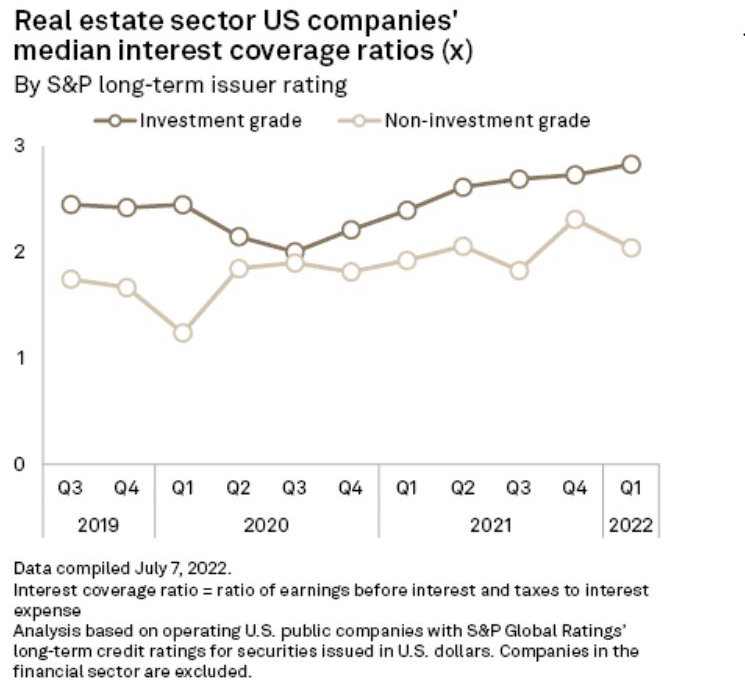
The median interest coverage ratio for nonfinancial U.S. companies rated investment-grade by S&P Global Ratings rose to 8.3 in the first quarter of 2022, up from 8.1 in the fourth quarter of 2021, according to S&P Global Market Intelligence data. The ratio is a measure of a company’s ability to repay its debts calculated by dividing earnings before interest and taxes by the cost of debt-interest payments.

The ratio is down from the recent peak of 8.6 in the second quarter of 2021. It is markedly higher, however, than the pre-pandemic level of 6.1, suggesting that companies are still well positioned to manage their debts. The median ratio for non-investment-grade companies slipped to 4.0 from 4.1 but remained higher than the pre-pandemic level of 2.8.

The apparent health of corporate balance sheets is reinforced by median debt-to-equity ratios, a closely watched measurement of corporate leverage determined by calculating total liabilities as a percentage of shareholder equity.

The ratio for investment-grade-rated companies fell to 90.1% in the first three months of the year, down from 90.5% at the end of 2021, the eighth consecutive quarterly decline. Debt is significantly less of a burden than it was before the outbreak of COVID-19. The ratio was 93.6% in the fourth quarter of 2019.

Companies took advantage of cheap credit conditions created by the Federal Reserve’s pandemic stimulus by issuing record levels of bonds in 2020 and 2021, building up cash buffers, refinancing debt at lower rates and pushing out the maturities of those debts.

The cost of borrowing has risen in 2022 as inflation pushed the Fed to raise interest rates and wind down the quantitative easing program that infused cash into credit markets. But the strong cash positions of companies has allowed them to rein in issuance, reducing their exposure to higher rates.

Lower borrowing enabled companies in six of the 10 investment-grade sectors and five of the non-investment-grade-rated segments to increase their median interest coverage ratios in the first quarter of 2022.

There were some declines. For non-investment-grade-rated information technology companies, the median ratio fell to 5.8 from 6.9, while the non-investment-grade energy ratio fell to 2.6 from 5.3. Both were higher than the pre-pandemic level.

Most sectors have also lowered their debt-to-equity ratios over the course of the pandemic. Investment-grade-rated health care companies, for example, posted a median ratio of 70.2%, well below the pre-pandemic level of 82%.
The consumer discretionary sector stands alone in having raised its debt relative to equity since the COVID-19 outbreak. For investment-grade companies, the ratio is up to 137.3% from a pre-pandemic level of 118.1% — still significantly lower than the peak of 170.7% in 2020.


 

Recent

7 Top SEC Exam Priorities for 2024

7 Top SEC Exam Priorities for 2024

The Securities and Exchange Commission has released its 2024 examination priorities to inform investors and registrants of the key risks, exam topics and priorities that the division plans to focus on in the upcoming year...
Prologis Explains Why Today’s Supply Chains Require More Logistics Space

Prologis Explains Why Today’s Supply Chains Require More Logistics Space

In today’s world, 57% more logistics real estate is required to support $1 billion in retail sales than a decade ago, a new analysis by Prologis has found. Ten years ago, 500,000 SF would have been sufficient to do the job. Today, 800,000 SF is needed. “Today, these supply chains amount to 1.2 billion SF and…
Why Real Estate Investors Like the Self-Storage Industry

Why Real Estate Investors Like the Self-Storage Industry

There are many reasons why the self-storage sector attracts real estate investors. For one, it is recession-resistant with predictable revenue. Also, customers for self-storage units are typically paying a relatively low rent, as opposed to single-tenant real estate such as retail or office buildings where occupants are on the hook for a bigger check each…
Prologis Looks at Four Global Trends Impacting Logistics

Prologis Looks at Four Global Trends Impacting Logistics

Logistics giant Prologis has been looking at the forces affecting logistics real estate and points to four areas that will have the biggest impact. First is a fall in volatility “because of the multiplier effect on demand and structural discipline in supply.” One is a “multiplier effect on demand.” More economic activity is now tied…

Most Popular

Blue Vault Q2 2023 Performance Reports Update

Blue Vault Q2 2023 Performance Reports Update

Blue Vault Q2 2023 Performance Reports Update 10-3-2023 Blue Vault wishes to acknowledge and apologize for the delay in publishing some Q2 2023 NTR Individual Performance Pages (IPPs) as well as the full review. We recently added additional reporting metrics to our IPPs, and that, combined with coverage of all share classes and some additional…
Blue Vault Q2 2023 Performance Reports Update

Blue Vault Q2 2023 Performance Reports Update

Blue Vault Q2 2023 Performance Reports Update 9-25-2023 Blue Vault has published the Q2 2023 Nontraded BDC Industry Review as well as Individual Performance Report and Limited Operations pages for the following offerings (newly published pages in bold font): Nontraded REITS American Healthcare REIT Q2 2023 Apollo Realty Income Solutions Q2 2023 (limited operations) Ares…
Blackstone Is the First Alternative Asset Manager to Hit $1 Trillion AUM. So Where Does It Go From Here?

Blackstone Is the First Alternative Asset Manager to Hit $1 Trillion AUM. So Where Does It Go From Here?

In July, Blackstone BX reported that it had surpassed $1 trillion in total assets under management during the second quarter of 2023, being the first alternative asset manager to cross that threshold. A bit of background to start: “Alternative asset management” is an umbrella term for asset managers that specialize in private market investment strategies like private…

Explore

Blue Vault Logo
Don’t miss alts news
and educational events

Subscribe Now