LEARN
Q&A
What is a professionally-managed real estate company?
According to the Institute of Real Estate Management, professional real estate management is defined as the administrative operation and maintenance of properties to meet the objectives of the properties’ owners. It also involves planning for the future of the properties by proposing physical and fiscal programs that will enhance the value of the real estate.
Professional real estate managers manage a property’s physical site, on-site and off-site personnel, funds and accounts, and leasing activities and tenant services. They’re also called upon to take on asset management functions with responsibility for financial and strategic tasks.
Professional real estate management emerged as a profession the 1930s after lenders foreclosed on thousands of mortgages and discovered that real estate management required specialized skills. (Source: Institute of Real Estate Management)
What is commercial real estate?
Commercial real estate (CRE) is broadly defined as any property that can produce income. The most common categories of CRE include office, retail, industrial, medical, hospitality, multi-family, land, and other leasable commercial space. More recent categories include self-storage, data centers, single-family rentals, and cell towers.
What does debt refer to in commercial real estate?
Debt, as most of us know, means borrowing money to make a purchase. In the world of commercial real estate, debt and financing are standard practices that allow buyers to make large real estate purchases without the need to pay the full price in cash up front from their own accounts. Financing is generally obtained from a bank, insurance company, or other institutional lender to provide funds for the acquisition, development, and operation of a commercial real estate venture. Commercial financing loans are secured primarily by real estate and related assets owned by the borrower.
What does a nontraded REIT buy or invest in?
Operationally, nontraded equity REITs have a lot in common with publicly traded REITs. Both types of REITs use investors’ money to buy properties – such as office, industrial, retail, or hotels – and they lease the buildings to tenants. Rent paid by tenants serves as income for the REIT, and this income is paid out in the form of dividends to investors.
Mortgage (or debt) REITs offer investors the chance to invest in real estate mortgages or mortgage-backed securities. They seek to earn income from the interest on these investments, as well as from the sales of mortgages to other buyers. Mortgage REITs have the same requirement as Equity REITs to distribute at least 90% of their income to their shareholders annually. They can invest in either residential or commercial mortgages.
What does a nontraded BDC buy or invest in?
BDCs – both traded and nontraded – invest primarily in private companies. They are required to invest 70% or more of their assets in U.S.-based private companies. This is an investment type that was previously limited to institutional and wealthy individuals through private equity and private debt funds. Now through these SEC reporting funds, retail investors have access to private equity and debt investments.
Many times, BDCs will invest in smaller or medium-sized businesses. BDCs may be diversified in the industries they invest in or have a specific industry specialization (i.e., energy, technology, healthcare). Additionally, they may focus on equity investments in companies, debt investments in companies or a hybrid of the two. BDCs utilize management teams and advisors to underwrite investments and make loans or equity investments into companies. So far, nontraded BDCs have primarily been focused on investing in the debt side of businesses.
What is a fund advisor?
A fund advisor acts as its external advisor and manages the fund’s day-to-day operations and its portfolio of real estate investments, and provides asset-management, marketing, investor relations and other administrative services on the company’s behalf, all subject to the supervision of the company’s board of directors. The advisor is typically a wholly owned subsidiary of the fund’s sponsor. Some of the fund’s board members and managers will typically be board members and managers of the fund’s sponsoring firm.
What is a sponsor/asset manager?
The sponsor of an alternative investment is an asset management firm that may have many investment vehicles, which can include real estate, private equity, hedge funds, credit funds, BDCs and other investment structures.
Many sponsors of alternative investments have introduced several products in the past, taking the programs from the IPO to a full-cycle event such as a listing, merger or liquidation. Each fund will have an external advisor which is a subsidiary of the sponsoring firm, and a board of directors with outside directors who usually serve on the audit committees. There may be considerable duplication of officers, board members and managers across a given sponsor’s alternative investment programs.
What is the difference between a dividend and a distribution?
In accounting terms, a “dividend” is typically a distribution from a corporation’s net income or retained earnings to its shareholders. Since commercial real estate investments have a unique tax advantage when owned by a REIT, the cash flows from real estate properties usually far exceed its net income as defined by Generally Accepted Accounting Principles or “GAAP.” This is due to accounting adjustments such as depreciation and amortization which reduce net income while not requiring cash outlays. Blue Vault reports “distributions” to stockholders from the REIT’s cash flows so as to not imply that such cash payments are always from net income. Distributions are funded from a REIT’s FFO (funds from operations) or MFFO (modified funds from operations) that are adjustments to GAAP net income that take into account depreciation, amortization and other non-recurring items that may reduce net income without reducing cash flows. In the early phases of a REIT’s life, distributions can also be funded in part or in whole from the proceeds of its public offering, until funds from operations are sufficient to fund all distributions.
How is a REIT tax-advantaged?
A REIT is a company formed to use investors’ pooled funds to invest them in properties. In the process, they can qualify for certain tax advantages in the eyes of the IRS. To qualify as a REIT, the company must pay out at least 90% of the money it makes in the form of dividends to the investors.
By avoiding taxation at the corporate level, REITs are able to pass on a greater portion of earnings to investors. This translates into potentially higher yields.
What is a blind pool?
In its broadest terms, a blind pool means that a company is selling stock without specifying how invested money will be spent. In the REIT world, it means that the REIT has begun fundraising by selling shares, but it does not yet own any properties. Investors entering a blind pool do so with the understanding that once enough money is raised, the REIT will invest accordingly in the types of properties identified in its prospectus.
When will I get my money back?
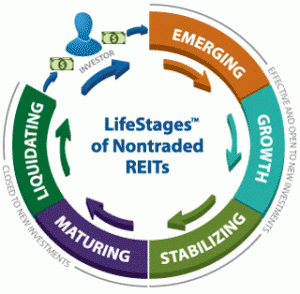
Most nontraded investments state in their prospectuses their targeted timeline for returning investors’ money. The REIT must first go through the distinct phases in its life cycle—emerging, growth, stabilizing, maturing, and liquidating—before it’s in a position to return investors’ money. This process can be long-term—maybe 10 years or more.
Once a REIT has reached the liquidation stage, investors can generally expect to be able to receive cash for their shares in the near future. If the REIT lists on a public exchange, investors can stay invested or they can sell their shares to liquidate their positions. If the REIT sells off its properties and liquidates, then investors can expect a check in the mail for the per-share market value of the REIT’s portfolio less the value of its liabilities (debt).
Why would someone invest in a Nontraded REIT?
There are a number of reasons to invest in REITs, including possibly higher investment yields due to favored tax treatment, the opportunity to earn dividends, and diversification from other asset classes.
Like the stock market, the publicly traded REIT market will have its day-to-day ups and downs based on investor sentiment; political, economic, and social events; or any number of factors. Nontraded REITs are not traded on a public exchange and tend to perform a bit differently from other assets. Their low correlation can offer diversification benefits and potentially lower overall volatility in the portfolio.
Why would someone invest in a Nontraded BDC?
BDCs are typically taxed as regulated investment companies. Similar to REITs, BDCs are required to distribute at least 90% of taxable income as dividends to investors, and as a result, the company itself pays little or no corporate income tax.
BDCs are required to invest 70% or more of their assets in U.S.-based private companies. These types of investments were previously limited to institutional and wealthy individuals through private equity and private debt funds. Through the most current generation of BDC funds, retail investors have access to private equity and debt investments advised by world-renowned investment firms. Adding nontraded alternative investments like BDCs can broaden investors’ diversification and reduce overall volatility in their portfolios.
What is a sponsor?
A sponsor is typically a company that creates an investment product and markets it to potential investors. It would file regulatory materials as needed and create a process for selling shares to the investing public.
What is a Broker Dealer?
The “broker” functions as an agent on behalf of an investor to facilitate trading. An investor opens an account with a brokerage firm and the brokerage firm carries out trading on behalf of the investor on a stock exchange where the investments are listed, or with a firm such as a nontraded REIT or BDC sponsor. The brokerage firm holds the investor’s assets in an account and issues regular reports to the investor on their holdings and the market value of their investments. The “dealer” function is where the broker dealer owns securities itself and buys or sells securities for its own account, either as investments or to re-sell to investors. These firms are regulated by the Financial Industry Regulatory Authority (FINRA) which is responsible for administering exams for investment professionals.
What is a wholesaler of NTRs and BDCs?
A wholesaler is typically employed by the nontraded REIT or BDC sponsor for the purposes of marketing the securities offered by the sponsor. For example, the wholesaler may direct marketing efforts toward financial advisors affiliated with Broker Dealers in order to gain awareness of a product sponsor’s offerings and competitive advantages.
How do I track performance? Are there benchmarks?
As with most investments, you’ll receive statements at least quarterly that show how much money you’ve invested in the REIT and how many shares you own. During the initial public offering, nontraded REITs sell their shares at a fixed share price, which is the price that will appear on your statement.
After the initial public offering, some REITs declare a different share value (net asset value per share) and change their offering price as the value of their investment portfolio changes. Some even publish daily adjustments to their net asset values per share and offer to issue or redeem their common shares at these daily prices.
It’s possible that a REIT could adjust the share price shown on your investment statements if it distributes any of your original investment back to you—also known as a “return of capital.”
Nontraded REITs are generally valued by the underlying real estate in their life cycle only after their equity offerings have concluded and independent appraisals have been conducted. It can take several years for the portfolio valuations to reflect the strategy and efforts of the sponsor.
Ideally, the real estate portfolio will command a value that is higher than its original cost, resulting in unrealized gains. In the final years of the nontraded REIT, the valuations of the properties are confirmed by the partial or complete sale of the portfolio, or by listing on an exchange.
The most widely recognized benchmarks for the nontraded REIT industry are available through the National Council of Real Estate Investment Fiduciaries.
How do I know that the REIT is a solid company?
As with any investment, there is no surefire way of predicting company stability. However, factors such as longevity, track record, previous full-cycle events, and approach to debt could offer clues about a REIT’s stability. Read prospectuses carefully, and discuss any concerns with your financial advisor.
What are the risks?
- Illiquidity – Once invested, your holdings in a nontraded REIT are generally not available to you until the REIT reaches a liquidity event.
- Market risks – Market events and trends can affect real estate performance. For example, a sector such as the hospitality industry may be affected by a decline in the overall economy and a reduction in consumer spending.
- Interest rates
- Variable- versus fixed-rate debt
- Hedging variable-rate debt
- Premiums and discounts to NAV
- Economic risks
- Tenant default/creditworthiness – The financial health of any real estate property—whether it’s an office building, hotel, or apartment complex—is dependent upon the entities that lease the property. If a tenant goes into default and cannot pay its rent, the REIT’s income will be affected.
Why was Blue Vault formed?
Blue Vault was founded in 2009 to provide transparency and education about nontraded alternative investments. Its goal then and now is to uncover valuable performance information about these often misunderstood investments while providing education to financial advisors and investors.
What does Blue Vault do?
Blue Vault uncovers valuable performance information that was once stored only deep inside financial statements and filings, and often is difficult to obtain. It is our mission to provide the most in-depth and thorough research available in the nontraded REIT and nontraded BDC industries to help educate financial advisors and help protect investors.
Blue Vault has combined numerous important metrics or data points to reveal how each professionally managed nontraded REIT and nontraded BDC is performing. These metrics include:
- Quarterly Performance Statistics for all Nontraded REITs and BDCs
- Commercial Real Estate Market Analysis and Nontraded REIT and BDC Industry Trends
- Full page Analysis and Commentary for each Nontraded REIT based on Real Estate Sector
- LifeStages Peer Comparisons and Analysis for Each REIT
- Performance Profiling System with Three Distinct Operational Measurements
- Current and Historical Performance, Dating Back to 2009
How do I subscribe to Blue Vault’s research?
Blue Vault is 100% independent, and we always have been. Our commitment when we started Blue Vault in 2009 was to provide complete transparency to those with a vested interest in nontraded REITs, and we have added similar coverage of nontraded BDCs. That commitment continues to this day.
Blue Vault has been less interested in what product sponsors have promised to do and more interested in what product sponsors have actually done. By tracking actual performance for every nontraded REIT from the early stages all the way through to the end, what we call the liquidity event, Blue Vault is capable of showing whether or not the investment fulfilled its investment strategy. We believe the best way to stay informed and make prudent investment decisions is to track and analyze what has actually happened in the past. With our LifeStage classification which recognizes the unique nature and life cycles of nontraded REITs, investors can be better informed to make wise investment choices.
Why do I need the Blue Vault report when my Broker/Dealer provides due diligence analysis for me?
The Blue Vault Nontraded REIT Industry Review was designed to consolidate quarterly performance metrics for every nontraded REIT in the market today so that you can quickly assess how the offerings you recommend compare to the industry as a whole.
There are currently over 69 nontraded REITs in the industry versus the limited number that may be available only through your Broker/Dealer. As a result, you will have a more thorough understanding of how the nontraded REITs you are recommending compare to the broader market.
Does Blue Vault receive compensation from REIT Sponsors in return for providing these reports?
No, Blue Vault is an independently owned and operated research firm that generates revenue through the sale of subscriptions and fees received from clients in return for providing custom research and consulting services.
Where does the information in the Blue Vault reports come from?
All information in the Blue Vault Nontraded REIT Industry Review is gathered from public sources. We do not make subjective comments about the REITs that we monitor because we believe it is important to let the facts speak for themselves. We do this by providing quantitative, fact-based research and analysis that can be consistently compared across all nontraded REITs within the industry.
Does your report include investment recommendations?
We are not an investment firm, we do not make future projections on what we “think” the REITs will do in the future, and we do not make, buy, or sell recommendations regarding the REITs that we monitor.
Commentary provided for each REIT in our report is done so in a manner consistent with our fact-based approach to reporting. It is meant to convey in more detail how each REIT’s metrics compares to its peers and the broader real estate market.
In addition, we offer regular commentary on the commercial real estate industry, and market trends within the nontraded REIT industry, and explain how recent events might affect the industry as a whole.
Upcoming Webinars
A Deeper Look at Black Creek Group and Resource
Analyzing BDCs and Their Investments
Explore
Asset Manager News
Asset Manager Perspectives
Service Provider News
Service Provider Perspectives
Industry News
Blue Vault Insights
Blue Vault Announcements
Inside the Vault
Webinars
Podcasts
Video Highlights
Industry Events


Access Detailed Asset Manager
and Offering Information
Become a member to access our detailed reports and get info on sponsor acquisitions,
capital raise and financials.